Friday, 3rd October 2025
Technical Update from the forensic excavation at the site of the former Mother and Baby Institution in Tuam, Co. Galway
Reporting Period: 23rd August to 24th September 2025
Forensic excavation of the site of the former Mother and Baby Institution in Tuam continues. In this reporting period, excavation has focused on three locations:
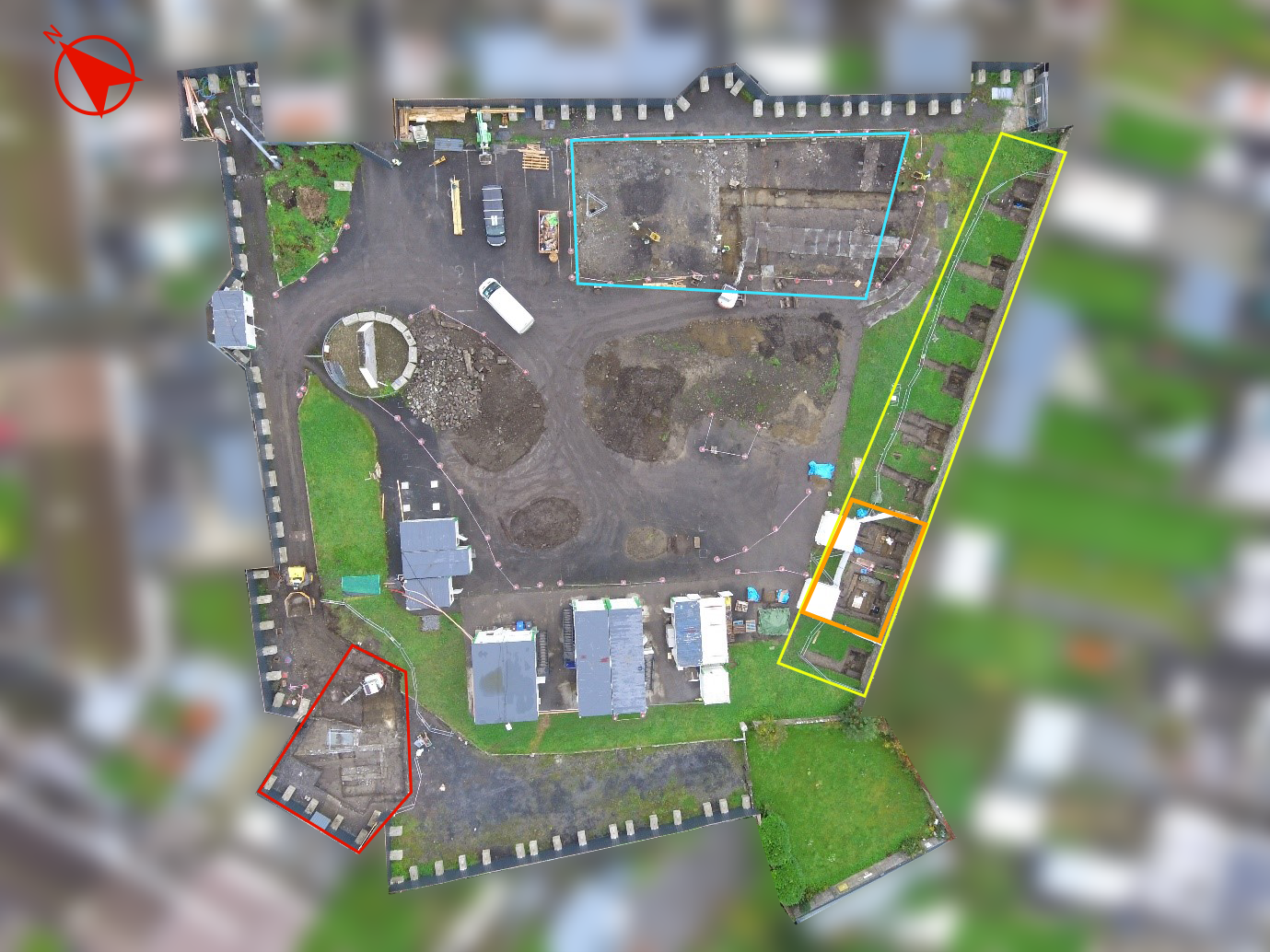
Location: The site of a former workhouse yard (outlined in blue in the photo below). Machine excavation continued in the site of the former workhouse yard.
Location: A part of the site adjacent to the high stone boundary wall at the eastern side of the site. Hand excavation continued in two (outlined in orange below) of the nine (outlined in yellow below) Test Trenches abutting the 19th century boundary wall.
Location: A part of the site (outlined in red below) where workhouse plans indicated a possible subterranean vaulted structure. Machine excavation began, intended to expose the vaulted structure indicated in plans of the workhouse. Exposure of these potential subterranean voids was necessary to safely excavate to forensic standards the lands adjoining.
The excavations have uncovered materials from four main eras in the site’s history:
- Post-institutional: 1961 onwards.
- Institutional (the era of the Mother and Baby Institution): 1925 to 1961.
- Military: 1918 to 1925.
- Workhouse: 1841 to 1918.
In locations where excavations have taken place to date, objects from all of these periods were identified and recovered, as well as objects from earlier ancient and unrelated dates. This highlights the complexity of the site.
Notable evidence recovered during the reporting period 23rd August to 24th September 2025:
Structures
In the intramural area southeast of the site of the former workhouse yard (blue outline), a northeast–southwest orientated concrete pathway was uncovered. It is flanked by features consistent with the foundations of a superstructure that covered or enclosed the pathway. A large, earlier, stone-lined drain was also uncovered crossing the yard on a northeast–-southwest axis.
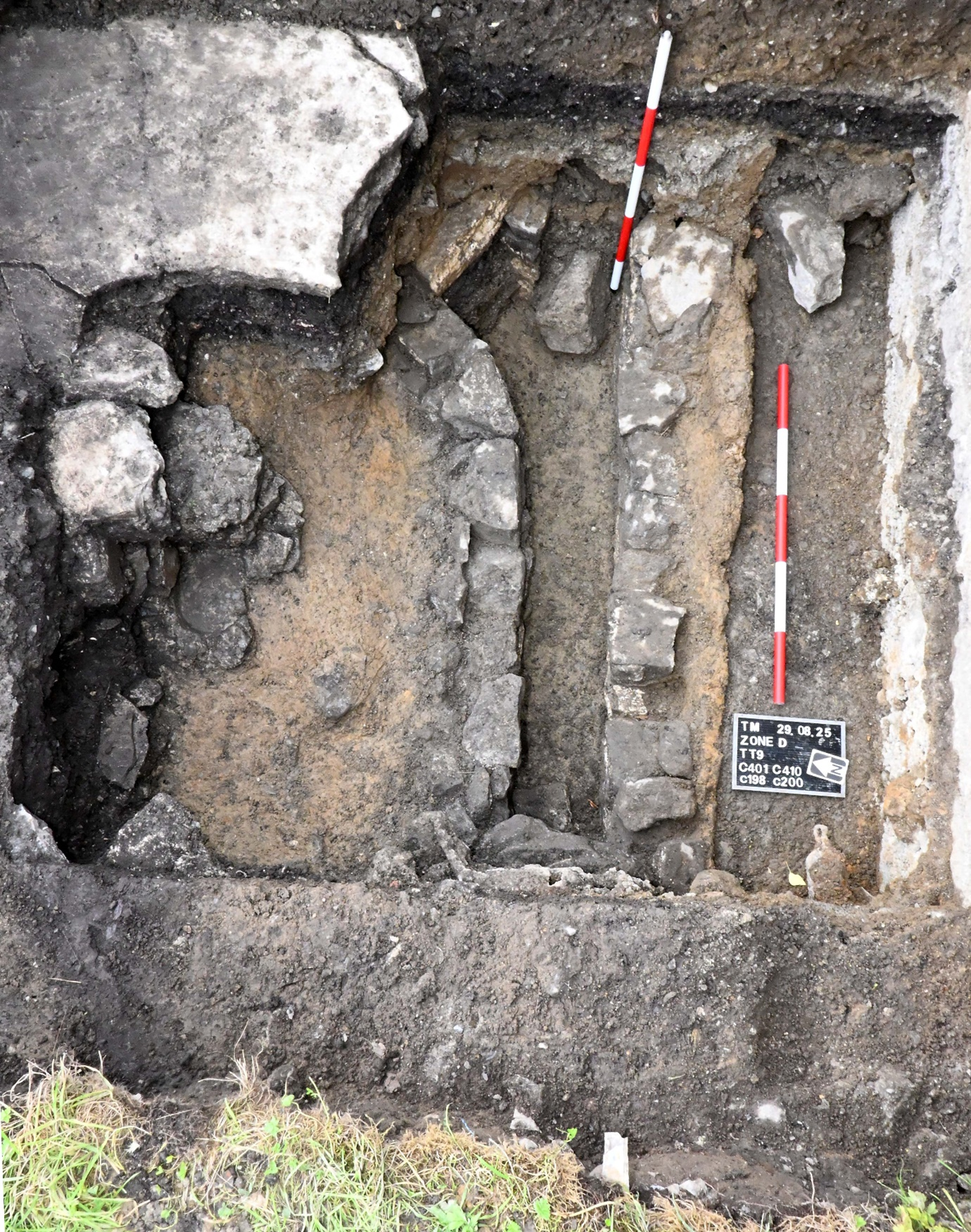
A stone-lined drain was also uncovered parallel to the high stone boundary wall at the eastern side (yellow outline) of the site (see photo).
Excavations at the location (red outline) where workhouse plans indicated a possible underground vaulted structure exposed that underground vaulted structure. It comprises at least three interconnected chambers, the ceilings of which are supported on brick arches. Access is blocked by building debris and the chambers cannot be entered safely. ODAIT is engaging with the main contractor and consulting engineer on how to make this chamber safe to excavate forensically. Please note that this is not the multi-chambered tank in the memorial garden, which was located in 2016/17. The memorial garden will be excavated later in this process.
Material evidence
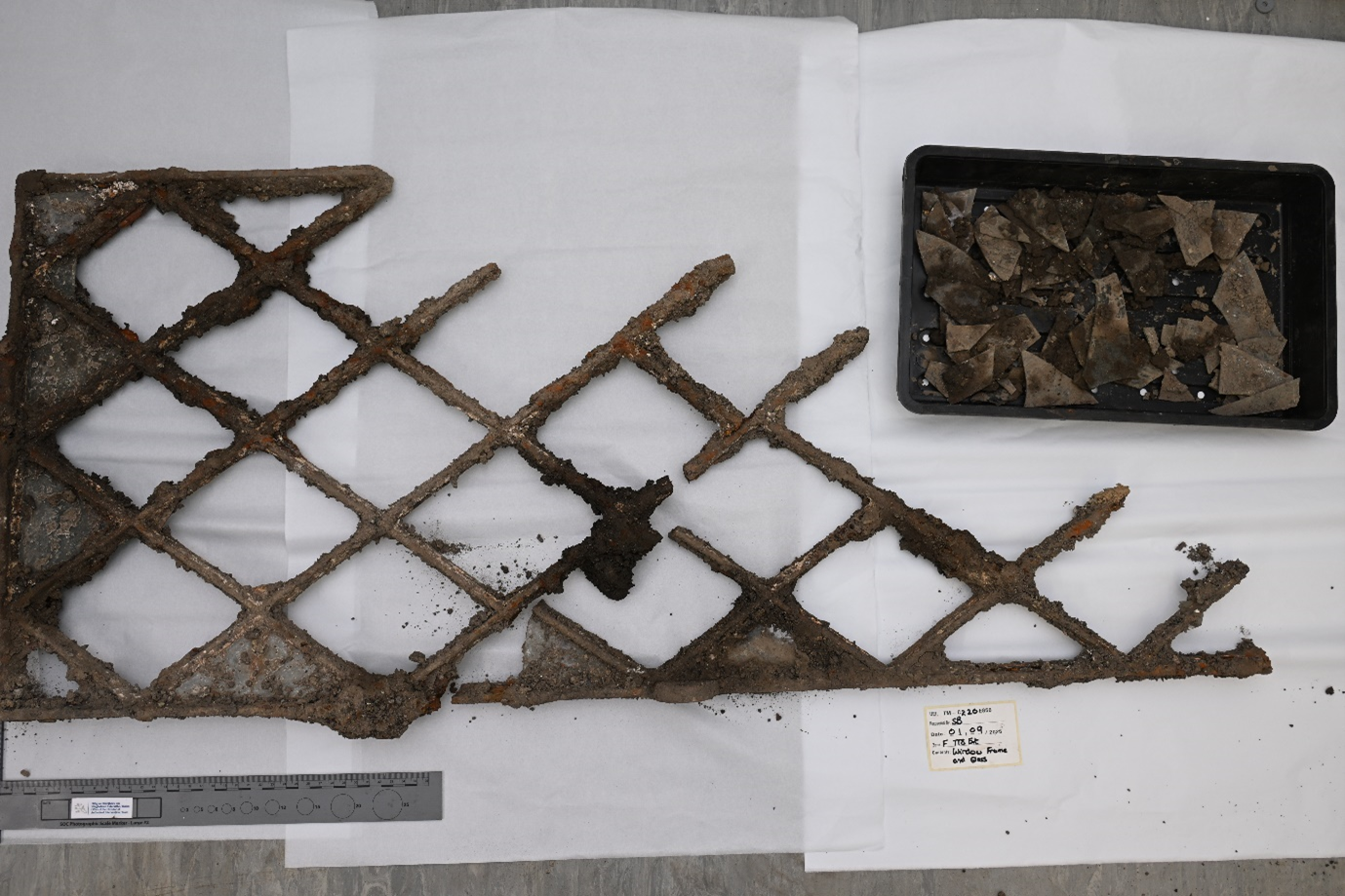
The excavations have recovered numerous objects including a window frame (see photo), personal and medicinal items dating from the institutional era, such as pottery, shoes, spectacles and glass baby bottle feeders. Lower layers contained glass bottles, clay pipes, enamelled tableware and chamber pots of pre-institutional date.
Human remains
ODAIT expert osteoarchaeologists confirmed that five sets of historic, skeletal human remains consistent with the Workhouse era (1841 to 1918) of this site were recovered from the area shown in orange in the image above. Further human remains were uncovered at the end of the reporting period and forensic excavation continues. In accordance with agreed provisions, ODAIT is cooperating with the National Museum of Ireland, the authority with responsibility for historic human remains. These human remains are currently undergoing analysis by ODAIT and more information will be shared once this analysis has progressed.
Concerning the single fragment of dissociated human adult tooth mentioned in the previous technical update (29 August 2025), no other human remains were found during the excavation of that part of the site. No further analysis of this tooth is planned at this time.
Animal bone
We continue to retrieve large amounts of animal bone, likely from the institution, military and workhouse kitchens.
All evidence recovered is being photographed, catalogued and retained by ODAIT. The excavation continues.
For more information about the excavation and recovery programme, please see www.odait.ie.
About the ODAIT Forensic Excavation
Excavation at the site of the former Tuam Mother and Baby Institution is being conducted by the Office of the Director of Authorised Intervention, Tuam under the Institutional Burials Act 2022.
In its day-to-day work, the ODAIT Forensic Excavation Team on site is led by the site co-ordinator. The team includes four forensic archaeologists, four osteoarchaeologists and forensic anthropologists, as well as a forensic evidence manager and a forensic photographer. They are supported by a main contractor who has supplied a team of construction professionals including skilled machine operators.
Forensic excavation commenced on 14th July 2025. This report covers weeks seven to eleven of the forensic excavation works on site, covering progress up until close of business (COB) on 24th September 2025.
ODAIT will provide updates to families and survivors and to the media on a monthly or bi-monthly basis.
Photos